

New drug: AI
When limitless possibility goes to dark places

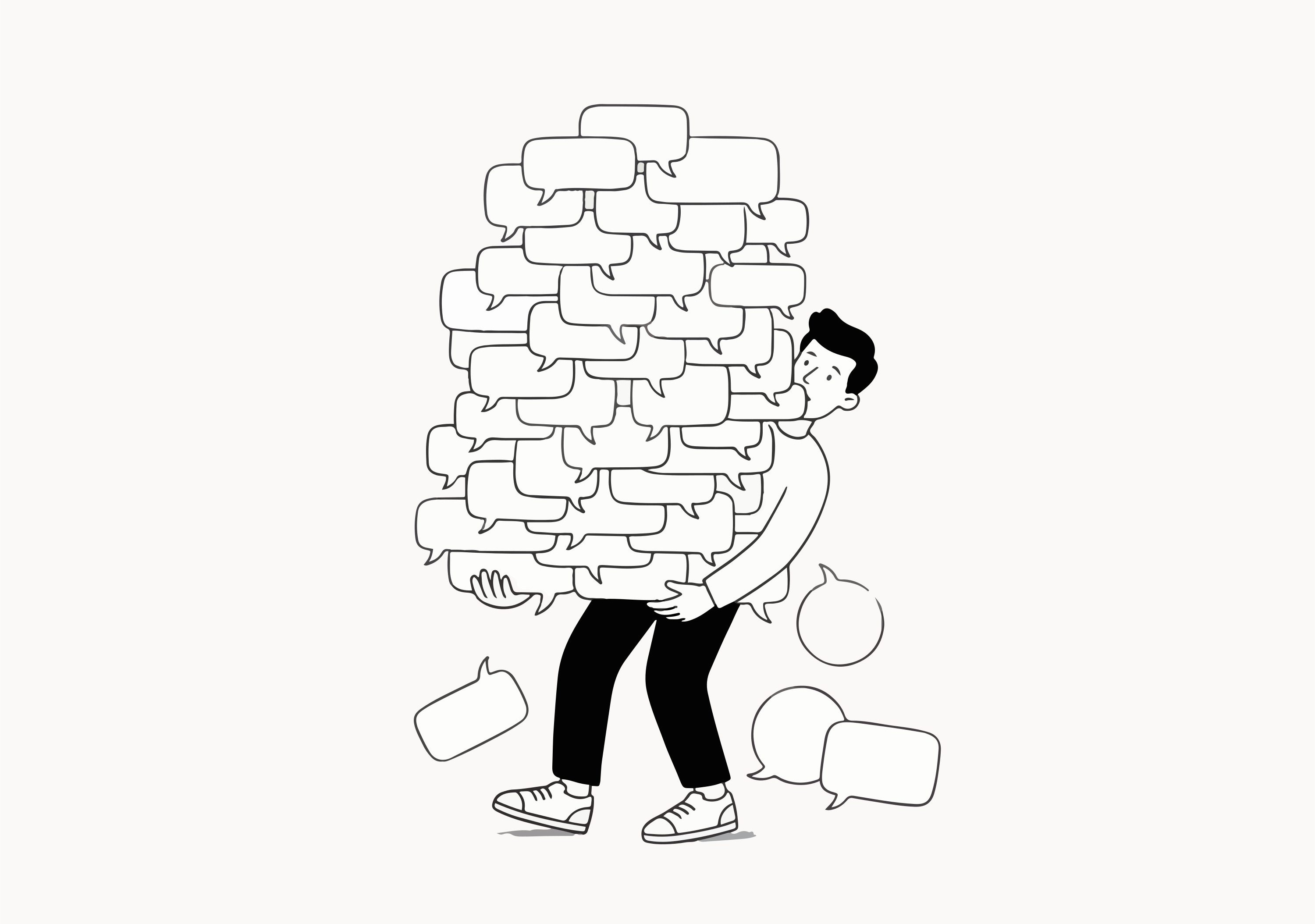
Are the powers AI gives us actually helpful, or are they more like the happiness you get from drugs? You get something, it feels incredible, you want more, and the deeper you go, the easier it becomes to lose your way.
The possibility tax
There is a hidden cost to having more options. Optionality turns into obligation, and you create unnecessary pressure on yourself just because more is possible.
Does this sound familiar?
If so, you are in, or about to enter, a dark loop. Just like me. So welcome. It is not that nice out here, but we get by.
Good old days
I am not sure how long it has been since we got AI this capable, but at the beginning it was a tool that tried to help. I used ChatGPT to ask coding questions instead of going through Stack Overflow and trying solutions one by one. If you know, you know.
This was a game changer. Then I started using it to write parts of the code: some function here, some refactor there. It was not perfect, but, as I said, it was a tool that tried to help.
Then Sonnet 3 came along. Cursor was popping off. Now I had AI inside my IDE, writing code directly with me.
The first time I used Sonnet 3, I knew this was going to change everything. I even started learning about project management and got a certificate, but not for managing humans. It was for managing AI agents. One thing was certain: I did not expect these days to come this quickly.
Models got better every month. Competition between OpenAI, Anthropic, and Google was brutal. Instead of writing the code, I started building workflows, finding patterns that made me go over the same things again and again, and trying to optimize more.
The more I optimized, the more I felt I could do.
That was the beginning.
The drug
If you have watched Limitless, you know the moment when he takes the first drug. Suddenly, there are limitless possibilities. Nothing can stop him. But there is also the drive to do more, because anything less feels like a waste of potential.
Daydreaming becomes part of your day. You think about all the things you can do, all the things you can achieve. Every time AI does exactly what you want, every time it helps you do something you could not do before, it feels like a dopamine hit.
After you overcome a challenge with AI, the next similar challenge does not hit the same. Yesterday’s breakthrough becomes today’s baseline.
Before AI, I might have had those big moments a couple of times a week at work. Maybe I found a solution to a difficult problem, made a decision that changed the project, or thought of and implemented a new feature. I felt accomplished.
Now, with AI, I can make tens of decisions, solve multiple issues at once, and build a feature before noon. The hits come and come until they do not. Finishing one thing stops feeling like an accomplishment.
So you stack tasks to get the feeling back. Then you stack projects. Even that does not feel the same.
That is the drug: the feeling that nothing should be impossible anymore.
The power you have becomes an obligation. You need to do more. You need to. Otherwise, you are wasting your potential. You are missing your chance in life.
You start feeling anxious, even depressed, while in reality you are doing more than you have ever done.
AI vampires
I am not a big fan of Marc Andreessen, but he said something on Joe Rogan that made me realize what I had become: an AI vampire.
“AI has not replaced programmers, but has instead turned them into ‘AI vampires,’ developers who stay up all night working because the massive productivity boost and continuous output of parallel coding agents make sleeping feel too costly.”
When AI first became popular, the idea was that it would help you and make your work easier. It definitely did. It still does. Unless you become addicted like I did.
Even sleeping starts to feel like you are missing out. It has a cost. If you are like me, you probably output more than most people. Others feel accomplished while you race yourself toward somewhere you do not even know is possible.
Success at one thing does not fulfill you anymore, so you start looking for more.
And if you think this is bad enough, you have no idea how bad it can get.
Delusional anxiety
Delusion takes over. Before, you might have had one or two projects at work and one or two side projects. Now that feels like nothing. It is not enough. There are too many possibilities, so why not do all of them?
Overworking and becoming an AI vampire might not be good for you or your mental health. But at least, in the beginning, there is still a direction. There is still a goal.
Things turn sour when you overclock your brain and the direction disappears. You think you have a goal, but you do not. You lost your way and did not even notice.
Working is the goal now.
You do not see what comes next. You only know that you need to be working, building, creating. That is the dark loop I mentioned: every day you wake up, do tons of things, go to sleep, and repeat.
Why? Because eventually you will achieve the unknown goal you have. And, of course, you will somehow know when you get there.
I was creating pressure around something I had never clearly chosen. The goal was imaginary, but the pressure and anxiety were real. I was so locked into the loop that activity itself looked like progress. I kept chasing the next big hit.
Wake up!
Productivity and efficiency mean nothing if you are not producing something real. You need to wake up. I needed to wake up.
I had lost focus on what was real and what was only possible. Eventually, reality hit me, and it was brutal.
Yes, I was capable of doing a lot. Yes, I could achieve more. But capability is not direction. I needed to choose one thing and decide what I was actually trying to achieve.
Detox
Time for action.
I thought doing less meant wasting my potential. In reality, I was wasting time, which was much more precious. I had to accept that this was no longer about building something. I had become addicted to the flow of building.
So what did I do to break out of it?
By the time I noticed the loop, I was already deep inside it. The action that saved me was going through everything and finding the projects closest to being finished. I started working on those and asking:
What is the goal of this project?
What did I plan to achieve?
Is it actually bringing value?
Can it become something?
That is when I noticed I was spending hours on projects that had become complex things, not products. They were more like abstract paintings that even I could not describe.
The feeling rushed over me. I had wasted so much time.
Happy ending
I came out of the dark loop, the delusional state where I was working hard for something but mostly working just to be working.
The realization hit in several ways, but the good thing was that I could finally step back and see the whole picture. I had been staring at small details without noticing the amazing things I had already done.
Even the side projects: yes, I would not continue most of them, but there were some gems. I could finally see everything at once. The solutions I found. The products I built. The projects where I actually had an idea, a goal, and a real possibility.
Those projects had been clouded by all the others because I did not know where to stop or what to do. I was more focused on working than on what I was working toward.
Now I have a clear head. I know what I am doing in my job and with my side projects. I have clear, defined goals.
Like an addict, sometimes the instinct to start another thing comes back. Now I know where that action leads, and I stop myself.
Being productive should be measured by the meaning of the outcome, not the amount of output.
There are limitless possibilities, but tackling all of them is not how I move forward. AI made everything feel possible. That did not mean all of it had to become my life.
I can try, fail, and succeed one step at a time. And I need to remember that I am already doing more.
Until next time, be cool.
-atkntepe